In 2026, the marketing funnel doesn’t look like a funnel anymore.
Customers don’t move neatly from awareness to purchase. They research, evaluate, disappear, return, take a look at opinions, click ads, ignore emails, and then all at once convert. The journey is messy—and that’s precisely why AI has become so powerful.
Artificial Intelligence now helps businesses understand where a person actually is in their decision process—not where we assume they are.
For brands investing in Digital Marketing Toronto, the biggest shift is this: marketing is no longer about pushing people down a funnel. It’s about responding intelligently to where they already are.
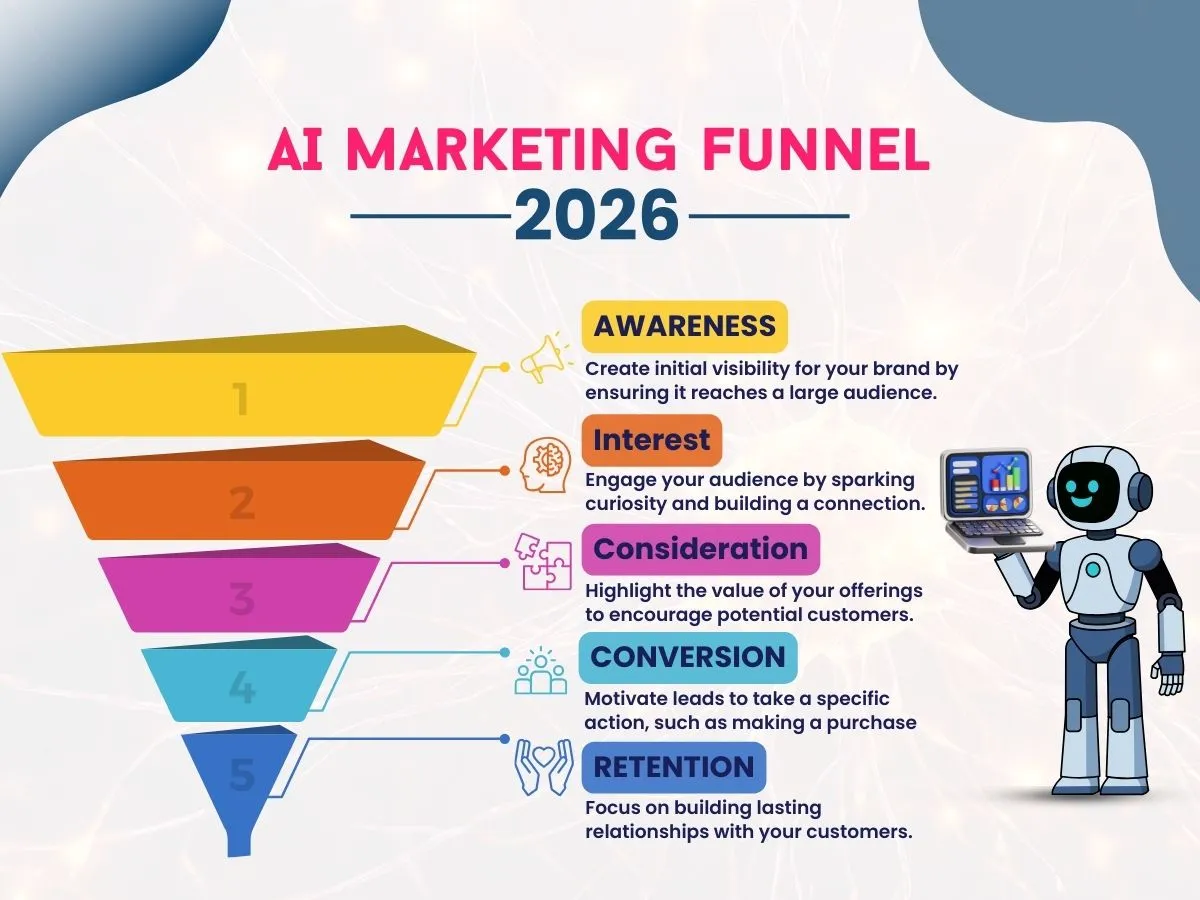
Stage 1: Smarter Awareness — Reaching the Right People, Not Just More People
At the awareness stage, AI has changed how businesses attract attention.
Before, Reputation once meant running large campaigns and hoping the right target audience would reply. 2026: AI analyzes conduct patterns, surfing signals, purchases, and engagement statistics to predict who is most likely to care—even before they are actively searching for it.
Instead of really specializing in demographics, AI now evaluates behavioral intent signals. It seems to depend on how humans interact with content, what topics they discover, and how frequently they interact with related industries.
This method of consciousness campaigns is not approximately quantitative. They’re about precision.
For organizations targeted on Digital Marketing Toronto and Canada, this shift prevents wasted ad spend and ensures visibility is strategic rather than random.
Stage 2: Understanding Consideration — Reading Intent, Not Just Clicks
The middle of the funnel is where most agencies lose momentum. People show hobbies but don’t convert. In 2026, AI allows deciphering why.
It’s now not enough to understand someone clicked a page. AI analyzes deeper behavioral indicators, such as:
- Time spent comparing services
- Repeated visits to pricing or case studies
- Engagement with specific types of content
These alerts monitor shopping temperatures. Someone casually surfing blog articles calls for distinct messaging from a person revisiting a service page a multiple of times.
This is where forward-thinking Digital Marketing Agencies integrate AI thoughtfully—no longer to automate blindly, but to customize thoughtfully. emails, retargeting ads, and content material guidelines adapt based totally on real behavior, not assumptions.
That personalization builds confidence instead of pressure.
Stage 3: Conversion — Timing Matters More Than Persuasion
In the beyond, conversion optimization is supposed to have stronger headlines or better calls to action. In 2026, AI makes a specialty of timing.
Sometimes people don’t convert because they’re not ready—not because your offer is weak.
AI can now become aware of high-possibility conversion windows by using reading engagement frequency, interaction intensity, and responsiveness. When a person indicates repeated sturdy reason alerts, messaging can grow to be more direct. When hesitation seems present, nurturing can be kept in preference to forcing the sale.
This reduces conversion friction and builds consumer trust.
For groups operating in aggressive markets like Digital Marketing Toronto, this degree of smart timing regularly makes the distinction between a closed deal and a lost opportunity.
Stage 4: Retention — The Funnel Doesn’t End at Conversion
The most neglected part of the AI advertising funnel is what happens after a person turns into a client.
In 2026, AI doesn’t prevent conversion. It continues learning. It analyzes usage conduct, engagement styles, and pride indicators to predict churn chance or upsell capability.
For example, AI can discover when a consumer’s interplay drops all of a sudden and trigger proactive outreach. It can also propose services based on previous engagement styles.
This transforms advertising from transaction-based to primarily relationship-based.
How Everything Connects in 2026
The real energy of AI isn’t in remote tiers. It’s in connecting the complete journey.
Instead of running separate campaigns for awareness, nurturing, and conversion, AI creates a nonstop comments loop. Data from one level informs the following. Messaging evolves as behavior evolves.
The businesses seeing the most powerful increase today aren’t the ones automating the whole thing. They are the ones combining AI intelligence with human oversight—ensuring the approach guides the gadget, not the other way round.
What Actually Works Right Now
In 2026, effective AI funnel optimization comes down to three principles:
- Clear positioning before automation begins
- Smart interpretation of behavioral signals
- Human strategy guiding AI execution
AI makes marketing faster. But clarity makes marketing effective.
Final Summary
The AI advertising funnel in 2026 is adaptive, behavior-driven, and continuously getting to know you. It allows businesses to transcend guesswork and respond to clients primarily based on real causes with insights supported by Eccentric Business Intelligence.
For businesses making an investment in Digital Marketing Toronto and Canada, operating with a forward-thinking Toronto Digital Marketing Agency ensures AI is used strategically, not automatically—specifically in aggressive markets like Toronto, wherein clever execution is what separates increase from noise.