What Actually Works in 2026
By 2026, AI is no longer a novelty in advertising. Automated ad structures, AI-written content, predictive analytics, and self-optimizing campaigns are widely handy. Almost each logo is using comparable gear, drawing from comparable facts, and relying on similar algorithms. Yet performance gaps between businesses are wider than ever.
The reason is no longer who uses AI.
It is who guides it better.
Brands that rely totally on automation are discovering its limits, whilst the ones combining AI with a human approach, judgment, and revelry are always outperforming.
Why Fully Automated Marketing Breaks Down Over Time
Automation performs best in stable, predictable environments. Marketing is neither. Consumer behavior shifts rapidly, cultural context evolves, and competitors constantly adapt. Fully computerized structures react to what has already taken place; they battle to assume what is ready to trade.
Over time, this leads to predictable problems. Campaigns initially perform well, then flatten. Messaging becomes repetitive. Creative loses relevance. Optimization keeps pushing the same patterns even when the market has moved on.
Common symptoms of over-automation include:
- Short-term performance spikes followed by stagnation
- Content that feels technically correct but emotionally empty
- Campaigns optimized for platform metrics instead of real demand
Automation is efficient, but it lacks interpretation and foresight.
What Human-Guided AI Marketing Actually Means
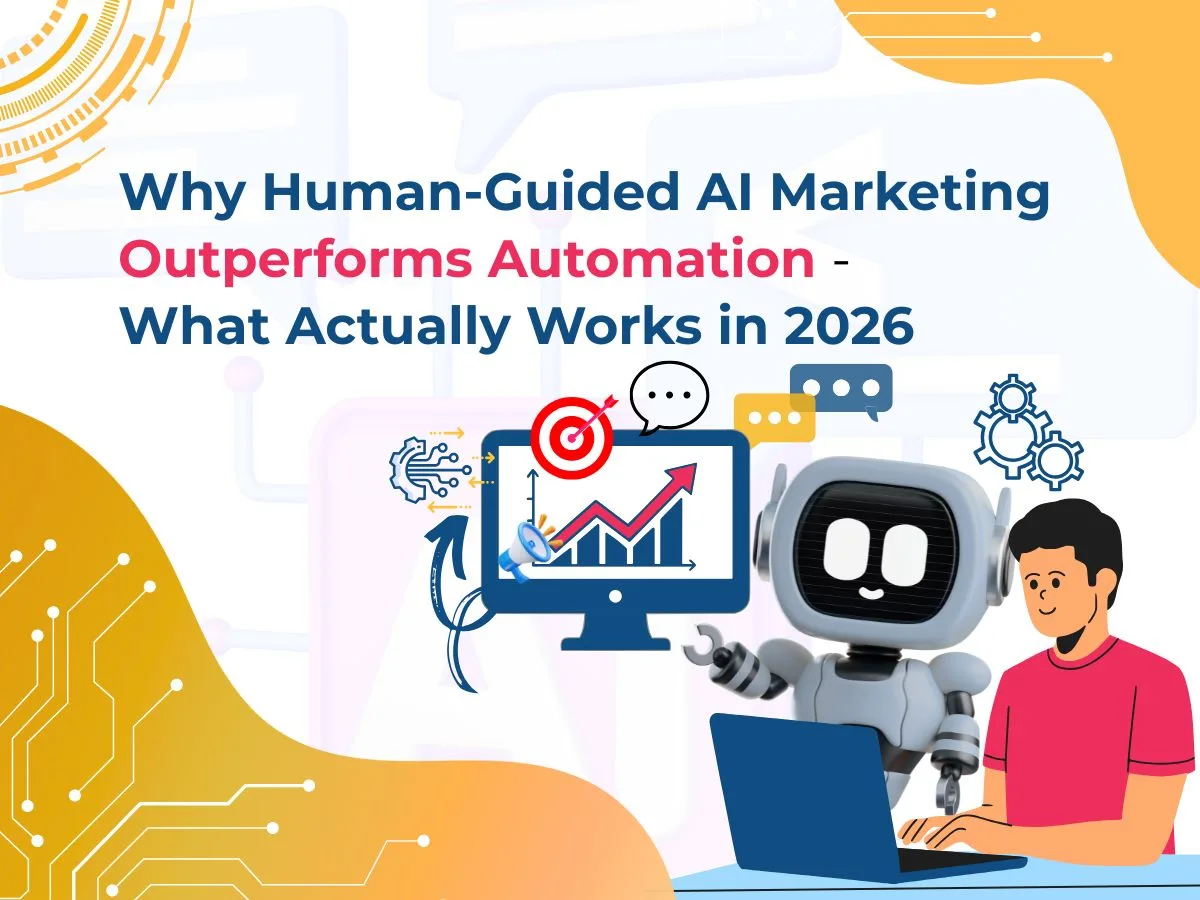
Human-guided AI marketing is often misunderstood as “less automation.” In reality, it is better-controlled automation. Humans define the direction, constraints, and priorities. AI executes within those boundaries at scale.
In effective human-guided systems:
- Humans define positioning, audience intent, and success criteria
- Humans decide what not to optimize prematurely
- AI handles testing, pattern recognition, and performance analysis
This structure prevents AI from optimizing in isolation and ensures that execution always supports the broader business objective.
Where Human Judgment Creates a Clear Advantage
There are areas of marketing where human insight remains irreplaceable, even in 2026. These are moments wherein knowledge context topics are greater than processing records.
Human-guided teams consistently outperform automation when it comes to:
- Interpreting intent beyond clicks and impressions
- Understanding emotional readiness and hesitation
- Adjusting tone and messaging based on cultural or market shifts
- Knowing when restraint creates more value than pressure
AI identifies patterns. Humans understand meaning. That distinction directly impacts results.
Campaign Optimization Beyond Algorithms
AI excels at micro-optimization. It can adjust bids, placements, formats, and delivery timing faster than any human team. However, strong marketing performance depends on macro-level decisions that automation cannot fully contextualize.
Human-guided optimization considers:
- Whether results align with long-term brand positioning
- If growth is sustainable or artificially inflated
- When to pause, pivot, or intentionally slow down
This is why human-guided campaigns remain stable even when platforms change rules, algorithms fluctuate, or costs rise.
Content That Feels Intentional, Not Generated
AI-generated content material is everywhere in 2026, and audiences apprehend it fast. While AI can boost up manufacturing, it cannot independently make certain relevance, readability, or persuasion.
Human-guided content workflows work because:
- Humans define the narrative and emotional framing
- Humans ensure messaging aligns with user awareness stages
- AI assists with scaling, structuring, and variation
The result is content that feels purposeful rather than mass-produced.
Turning Data Into Insight Instead of Noise
Modern marketing systems generate enormous amounts of data. AI can process it instantly, but processing does not equal understanding. Automated systems optimize based on available signals—even when those signals are incomplete or misleading.
Human interpretation adds the missing layer by:
- Questioning conclusions instead of accepting them blindly
- Identifying false correlations and data gaps
- Applying real-world business and market context
This prevents teams from optimizing in the wrong direction simply because the numbers looked good.
What Actually Works in 2026
High-performing brands in 2026 follow a consistent operating loop:
- Humans define strategy, positioning, and boundaries
- AI executes testing, delivery, and optimization
- Humans interpret outcomes and adjust direction
- AI re-optimizes within updated guidance
This creates a learning system, not a rigid automated machine.
Final Perspective
Automation reduces effort, but effort was never the true bottleneck in marketing. AI accelerates execution, but speed alone does not create meaning, trust, or loyalty.
Human guidance is what turns capability into advantage.
As we move through 2026, the brands that continually outperform aren’t those chasing the most up-to-date AI tools or automating each selection. They are the ones that recognize something deeper: an era is only as handy and effective as the thinking that directs it. These brands use AI to extend insight, not replace it. They combine data with judgment, scale with context, and automation with intent.
When human strategy leads and AI helps, advertising becomes more than green—it will become intelligent. AI stops being a shortcut and starts functioning as a strategic asset, guided by clarity, experience, and reason. That is where sustainable growth lives—now not in changing human thinking, but rather in strengthening it.
At Eccentric Business Intelligence, human-guided AI advertising is dealt with as a strategic discipline, not only a technical capability. The attention is on aligning AI-driven execution with human perception, marketplace focus, and long-term brand reasoning. By placing approach and judgment before automation, Eccentric Business Intelligence allows corporations to avoid the commonplace pitfalls of over-optimization and build marketing structures that adapt intelligently as markets, platforms, and purchaser conduct evolve.